
Supporting learners who rely on AAC and/or have complex access needs to become readers and writers
Author: Marion Stanton, MA, Adv. Dip. Ed. (special), PGCE, AAC/AT Level 7, MCCT
Abstract: Learners who rely on Augmentative and Alternative Communication (AAC) should have access to phonics instruction, but not through a synthetic-phonics-only pathway. Phonics should form part of a comprehensive approach to literacy, rather than being treated as a prerequisite for wider literacy experiences. This is especially important for learners in Key Stage 2 and above, where literacy teaching must begin with an understanding of access needs, working memory demands, cognitive processing, AAC-specific adaptive teaching and the application of reasonable adjustments.
Reading for pleasure, shared reading, guided reading, comprehension work, vocabulary building and meaningful writing should sit alongside adapted phonics and explicit teaching of spelling and transcription. For learners who rely on AAC, literacy development depends not only on code-based instruction, but also on access to language, text, authorship, communication and purposeful written expression.
Current English policy and guidance in England strongly emphasise systematic synthetic phonics. However, Department for Education guidance also recognises that pupils with complex needs may require adaptation, and that a very small number of pupils with Profound and Multiple Learning Difficulties (PMLD) may not access direct literacy instruction in the same way as their peers. What remains underdeveloped is a clear, practical and evidence-informed literacy pathway for learners who rely on AAC, or who could benefit from AAC.
This article urges mainstream and special schools to raise their expectations regarding students who have communication and physical difficulties masking their real learning potential and to offer all students access to meaningful literacy learning.
Introduction
This article examines the evidence for teaching meaningful literacy to students who rely on augmentative and alternative communication (AAC), students who may benefit from AAC, and students with complex communication and motor access needs. Literacy is understood here as the development of text-based reading and writing, including decoding, comprehension, spelling, vocabulary, composition and written communication.
For this group of learners, successful literacy acquisition may require pathways that differ from those commonly used with speaking and non-disabled students. However, difference in route should not be confused with reduction in ambition or the blocking or delaying of literacy learning. Students who rely on AAC require access to rich and purposeful literacy teaching, supported by adaptive teaching, reasonable adjustments and careful attention to access, cognition, language and motor demands.
The problem is not phonics. The problem is treating synthetic phonics as the only valid pathway into literacy. AAC users also need analytic, analogic, embedded, morphology-informed and AAC-specific phonics, with spelling taught through meaningful reading, comprehension, vocabulary and writing.
The article explores the teaching approaches and adjustments needed to make literacy instruction accessible and meaningful. It considers the role of phonics within a broader literacy framework and provides examples of how reading, writing, vocabulary development and communication can be taught in ways that support students who rely on AAC to participate as readers, writers and meaning-makers.
Literature Review
Literacy is not simply another curriculum subject for learners who rely on AAC; it is a route to autonomous, generative communication. Symbol-based AAC vocabularies can support participation, choice-making and classroom interaction, but they cannot anticipate every name, curriculum term, place, feeling, grammatical form, literary phrase or personal message that a learner may want to express. Without access to spelling, reading and writing, the learner remains dependent on vocabulary selected, organised and programmed by others; literacy therefore extends communication beyond pre-stored messages and graphic symbols into self-authored language. This is why literacy teaching for AAC users must not be displaced by a narrower focus on symbol recognition, device navigation or functional requesting. The risk is well evidenced: AAC users may be excluded from literacy instruction, offered literacy tasks that require spoken responses, supported by professionals who lack training in accessible literacy teaching, or given AAC systems that do not support the transition from graphic symbols to text (Light et al., 2025). The American Speech-Language-Hearing Association (ASHA) similarly notes that lack of literacy can restrict AAC users to non-orthographic symbols and limit novel message generation, while Erickson et al. argue that learners with significant disabilities have too often received reductionist functional word instruction rather than comprehensive reading and writing teaching (ASHA, n.d.; Erickson et al., 2009).
In educational practice, students who rely on AAC, or who have complex access needs, are often supported through the addition of pictures and symbols to written text. However, research suggests that when symbols are placed above or below words, learners may focus on the symbols rather than the print.
Symbols alone are also only useful as reading aids for very simple ideas. Their overuse can distract from text, limit language development and delay literacy. Symbols and pre-programmed AAC pages are essential for participation, choices, social interaction, classroom routines and self-advocacy, but they are not a substitute for literacy.
A similar issue arises with descriptive teaching. This approach encourages learners to use common core and high-frequency fringe words to describe more complex ideas, rather than adding many low-frequency topic specific words to communication pages. It has value because it helps learners use core vocabulary creatively and show broad understanding (Van Tatenhove, 2009; Witkowski and Baker, 2012). However, it can also restrict expression if it replaces access to specific vocabulary, spelling, keyboard use and text-based writing.
A fixed symbol vocabulary cannot contain every name, topic word, tense form, literary phrase, technical term, morpheme or personal message a learner may need. For example, a Year 3 learner writing a horror story may want words such as ghoul, descended, terrifying or howl, but these may not be available in a commonly used symbol-based vocabulary. Thus language rather than thought is being limited if a descriptive teaching approach is adopted. The learner may know what they want to say but lack the tools to say it.
The same applies to curriculum learning. Using descriptive teaching, a learner might describe photosynthesis as plants needing light and water, taking in “bad gas” and giving out “good gas”. This may show some understanding, but it is not precise enough for subject learning or qualifications. The learner also needs access to words such as chlorophyll, chloroplast, glucose, oxygen, carbon dioxide, starch and respiration.
Descriptive teaching therefore has a place in AAC practice, but it should not replace technical vocabulary, spelling, keyboard access or print-based literacy. Learners who rely on AAC need both flexible communication and direct access to literacy, so they can use precise vocabulary, generate independent messages and take part in qualification-level learning (Erickson and Koppenhaver, 2020).
Proud’s (2021) survey suggests that literacy intervention for AAC users may be reduced or discontinued not because literacy is unimportant, but because professionals face practical barriers such as limited training, confidence, materials and caseload capacity. In some cases, intervention also appears to be stopped because difficulties are attributed to the learner’s own impairments or “readiness”, rather than being understood as access and teaching barriers that require adaptation. Students who might benefit from AAC but do not yet have access to it run the risk of being assessed as having less cognitive ability than is, in fact, the case.
For example, students with the label of PMLD should not be assumed to be beyond literacy simply because their communication, movement, sensory or access needs make their understanding difficult to observe. The label describes a high level of support need; it should not be used as a ceiling on learning potential. There is evidence that people with PMLD are often underestimated: Gjermestad et al. (2023) report that it is “all too common” for others to underestimate what people with PMLD can achieve and do. For this reason, learners with PMLD should be given regular access to text-based literacy, including shared reading, meaningful print, vocabulary, letter and word work, adapted response methods and AAC-accessible opportunities to show recognition and understanding. This does not mean forcing all learners through a standard reading scheme, but it does mean ensuring that low expectations do not remove access to print before the learner has had a fair opportunity to demonstrate what they can understand and learn. The DfE reading framework (2023) supports this position, stating that only “a very few” pupils with PMLD may be unable to access direct literacy instruction, and that pupils with complex needs may require adapted strategies and much longer timescales rather than exclusion from reading instruction altogether. It does however allow for disapplication for students with PMLD which could be seen as a contradiction.
There is no robust population-wide statistic showing what proportion of AAC users have normal cognition, because AAC users are a heterogeneous group.
However, in cerebral palsy, one of the major groups who may require AAC, research suggests that around half of children do not have intellectual impairment; for example, Wotherspoon et al. (2023) found that 44.1% of school-aged children with CP met criteria for intellectual developmental disorder, implying that 55.9% did not. This makes it unsafe to infer cognitive impairment from a person’s need for AAC. Even when students who rely on AAC have strong cognitive skills, they are often at risk of delayed literacy development because they have reduced access to spoken rehearsal, informal print experiences, independent writing, direct instruction and fast participation in classroom literacy tasks. Dahlgren Sandberg and Hjelmquist (1996) found that nonspeaking children with cerebral palsy who were matched with nondisabled peers for age and intellectual level still scored lower on reading and writing measures, with the authors reporting that “the comparison group…scored higher” despite comparable phonological awareness. Peeters et al. (2009) similarly found that children with cerebral palsy “lag behind on all reading precursors” early in schooling.
Many learners who rely on AAC need the same long-term literacy ambition as their speaking peers: to read with understanding, write for authentic purposes, learn curriculum vocabulary and generate their own messages. Comprehensive literacy instruction for learners with significant disabilities includes shared and independent reading, writing, phonological awareness, vocabulary, comprehension, decoding and spelling, while AAC research emphasises communicative competence, language development, literacy and participation rather than restricted or low-level communication goals (Erickson and Koppenhaver, 2020; Light and McNaughton, 2014; Light et al., 2019). The route may need to be different, but the aspiration remains the same.
Hedrick, Katims and Carr’s study challenges the assumption that learners with learning difficulties should receive only functional or isolated word-reading instruction. In a year-long classroom study, nine elementary-aged pupils with mild to moderate intellectual disabilities were taught through an adapted Four Blocks literacy framework, combining guided reading, self-selected literature, word work, phonics, sight-word teaching and meaningful writing. The pupils made measurable gains in concepts about print, story retelling, sight-word vocabulary, early decoding, writing behaviours and confidence with written language. Although the study was small and descriptive, rather than experimental, it supports the argument that learners with significant cognitive and communication needs benefit from broad, balanced and meaning-rich literacy teaching, rather than a narrow curriculum limited to decontextualised phonics or basic functional words (Hedrick, Katims and Carr, 1999).
More recent studies suggest that AAC users can make gains from phonics-based reading instruction when programmes are adapted so that learners do not have to produce spoken responses. For example, Linder et al. (2023) adapted a phonics-based programme for students with intellectual disabilities who used AAC by using pointing responses, internal speech and iPad-based reading and spelling activities; all three participants improved in word reading, although spelling outcomes were less consistent. Ahlgrim-Delzell et al. (2016) also found that students who received an iPad-based phonics curriculum outperformed students receiving sight-word instruction, with responses made through the device rather than through speech. However, this evidence base remains limited. Yorke et al.’s (2021) systematic review found positive effects for adapted foundational reading interventions for AAC users but also noted the need for research beyond highly controlled settings, including studies delivered by everyday teachers and service providers. The evidence therefore supports adapted phonics as a useful component of literacy teaching for AAC users, but it does not yet establish that phonics alone, or synthetic phonics specifically, is superior to broader approaches to literacy.
For children following the standard school literacy pathway, phonics is often treated as an early foundation providing access to decoding skills that aims to improve fluent reading. In England, the phonics screening check is normally taken at the end of Year 1, when children are typically six, and repeated in Year 2 for pupils who have not met the expected standard. Because phonics screening results are also used as an indicator of how effectively schools are teaching early literacy, this accountability pressure may contribute to reluctance to adapt the check for AAC users, even where adaptation would be necessary to allow pupils to demonstrate their knowledge.
The National Curriculum frames phonics as especially important in the early teaching of reading to beginners, while also making clear that reading develops through both word reading and comprehension, and that pupils should move into wide reading, vocabulary growth, discussion of texts, fluency and writing for meaning. This age-linked model of literacy development is not appropriate when planning for older AAC users. Many older AAC users have missed literacy teaching or lacked age-expected instruction when they were younger. They may not have had ordinary access to early phonics because traditional phonics teaching often assumes speech, oral blending, verbal sound production and rapid spoken responses. Whilst Yorke et al.’s systematic review found positive effects when phonological awareness, letter–sound correspondence and decoding interventions were adapted for AAC users, they also noted the need for research beyond controlled settings and researcher-delivered interventions.
Older learners who rely on AAC need adapted phonics within a broader, age-respectful programme that includes shared reading, comprehension, vocabulary development, word prediction, curriculum texts and purposeful use of print. Erickson and Koppenhaver’s (2020) comprehensive model supports this wider view, presenting reading and writing for students with significant disabilities as an ongoing process.
The two key issues seem to revolve around firstly, whether synthetic phonics should be the only phonics approach that is offered to this group of learners and secondly, whether that approach should precede wider literacy teaching in a comprehensive literacy model.
Phonics first or comprehensive literacy?
There continues to be debate about the efficacy of a synthetic phonics, first and foremost approach for the general school population.
The case for synthetic phonics first
The strongest argument for synthetic phonics first is that reading English requires learners to understand how written symbols map onto sounds. A child who cannot decode is dependent on memory, guessing, adult support, or pictures.
Explicit phonics makes the alphabetic code visible instead of assuming that children will infer it from exposure to books. That matters most for pupils who do not arrive at school with strong print knowledge, strong phonological awareness, or rich early literacy experience. The Education Endowment Foundation (EEF) (2026) similarly treats phonics as a low-cost, evidence-supported approach, while noting that it should be matched to the child’s phonemic awareness and grapheme knowledge.
Synthetic phonics also has a fluency argument behind it. Kuhn, Schwanenflugel and Meisinger (2010) argue that fluency involves accuracy, automaticity and prosody. Accurate and automatic word recognition reduces the cognitive load of decoding, making it more possible for the learner to attend to meaning, phrasing and comprehension.
However, perhaps the most prominent support for the synthetic phonics argument is not “phonics only”. The Rose Review (2006) which led to the introduction of synthetic phonics as mandatory in England, placed high-quality phonic work within a “language-rich curriculum” and described good teaching as helping children apply decoding and encoding skills to fiction, non-fiction and wider curriculum content.
So the pro-phonics-first position is that children need explicit, systematic teaching of the alphabetic code early, because decoding is a gateway skill. But phonics must be purposeful, applied in reading and writing, and quickly connected to fluency, vocabulary, comprehension and real texts.
The case for comprehensive literacy from the start
The strongest argument for comprehensive literacy is that reading is not the same as decoding. Decoding is necessary, but reading also involves meaning, language, vocabulary, syntax, background knowledge, motivation, text experience, writing and fluency. The EEF explicitly notes that phonics improves reading accuracy but does not necessarily improve comprehension, so vocabulary, spelling and comprehension also need explicit teaching.
Bowers (2020) challenges the claim that systematic phonics has been shown to be superior to common alternative approaches. His argument is not that children should avoid learning grapheme-phoneme correspondences; rather, he argues that the evidence has often been overstated and that existing meta-analyses do not reliably prove that systematic phonics is better than approaches that also include phonics, morphology, spelling patterns and meaning-based word work.
Wyse and Bradbury (2022) make a related policy argument. Their review and teacher survey conclude that England’s strongly synthetic-phonics-oriented policy is not sufficiently underpinned by the most robust evidence, and that contextualised or balanced instruction is more consistent with the wider research base. Hynds goes further, arguing that the Rose Review used persuasive policy language to justify a narrow synthetic phonics approach despite controversy and disputed evidence. That is a critique of policy discourse as much as a critique of phonics itself.
The fluency literature also supports a broader view. Kuhn et al. (2010) warn that fluency can be narrowed when assessment focuses too heavily on speed and accuracy because these are easier to measure. They argue for a broader understanding that includes phrasing, stress, pace, prosody and comprehension. That matters because a child can pass a decoding check yet still not read with understanding, expression, independence or enjoyment.
Wyse and Hacking’s (2024) Double Helix model builds the comprehensive position directly. It presents reading and writing as intertwined with language, meaning, motivation, text experience and the child’s environment. In the Double Helix model, phonics is prominent, but it is not treated as a separate hurdle to be completed before children progress on to real reading and writing.
So the comprehensive literacy position can be explained as: phonics is necessary, but it should be taught inside a wider literacy curriculum from the beginning, not as a precondition for meaningful reading and writing. Learners need code knowledge, but they also need books, vocabulary, comprehension, writing, discussion, morphology, fluency, motivation and access to real purposes for literacy.
The balanced conclusion
The balanced position does not juxtapose “synthetic phonics first” versus “comprehensive literacy” as if they are opposites. Instead, it distinguishes between explicit code teaching within a rich literacy curriculum and a narrow phonics-first pathway that delays wider literacy experiences.
Fletcher, Savage and Vaughn’s (2021) response to Bowers defends explicit phonics, but they also reject a simple phonics-versus-whole-language argument. They conclude that the better question is how to combine different components of evidence-based reading instruction into an integrated and differentiated approach for each learner.
The evidence supports explicit teaching of phonics, including systematic attention to grapheme-phoneme correspondences, blending and segmenting. However, the evidence does not justify reducing early literacy to synthetic phonics alone, nor does it justify delaying rich reading, writing, vocabulary and comprehension work until phonics is secure. The strongest position is that phonics should be taught explicitly and accessibly within a comprehensive literacy framework. This is especially important for learners who rely on AAC or have complex access needs, because literacy is not only a school skill but a route to independent, generative communication. Additionally, this group of learners, because of their access needs and multiple other challenges, may take longer to achieve literacy milestones which may take them beyond the age at which any proponent of phonics first could defend a phonics only approach.
The evidence for systematic phonics is strongest as an early, beginning-reading intervention, particularly for children in the Reception/KS1 stage. English policy reflects this by placing phonics at the centre of Year 1 and Year 2 word-reading instruction, while expecting the emphasis to shift in KS2 towards fluency, vocabulary, comprehension, morphology, spelling, writing and curriculum reading. This does not mean older learners who rely on AAC should be denied phonics. It means they should receive phonics where it is still needed, but not through an age-inappropriate “phonics first and everything else later” pathway. For older AAC users, phonics should sit inside a comprehensive, age-respectful literacy programme that includes real reading, writing, vocabulary, comprehension, spelling and access to meaningful curriculum content.
Prerequisites to learning literacy for students who rely on AAC
Instead of beginning with, ‘Which phonics phase is the learner on?’, we need to first establish whether the learner can access the learning materials they need. Can they reach, use and take part in the literacy activity in a meaningful way?
A speaking child may hear a word, say the sounds, blend them and respond. An AAC user may need to hold the target in memory, control eye-gaze or switches, wait for scanning, navigate to letters or symbols, manage prediction choices and then select a response. The learner is not just doing phonics; they are doing phonics plus motor planning, visual search, timing, working memory, access and communication.
Synthetic phonics often works through pace. It can be fast, verbal and output driven. Learners are expected to hear, rehearse, repeat, blend, segment and respond quickly. This is supported by government guidance which emphasises short, frequent, high-quality phonics sessions. That pace may be appropriate for many young speaking children, but this is not necessarily so for a learner who needs much longer to process, plan and produce a response.
Having some speech does not solve this. A learner may be able to produce some spoken sounds but still be unable to access a fast verbal phonics lesson.
Speech may be effortful, unclear, slow, motorically unreliable or cognitively draining. The issue is not whether the learner can say a sound; it is whether they can participate in the task at the speed, rhythm and output level required.
This is where cognitive load becomes important. If the response route is too heavy, output may collapse even when comprehension is present. The learner’s cognition may be ahead of the skill they can demonstrate through that task. For AAC users, good teaching reduces the wrong kind of difficulty – motor, memory, speed and access barriers – while keeping the thinking at the appropriate level of demand.
Communication and Learning Enterprises (CandLE) is a not-for-profit organisation that has been working to change how students who rely on AAC and/or have complex access needs can participate in education so that their entry into, experience of, and the outcomes that they derive from the education system are equitable.
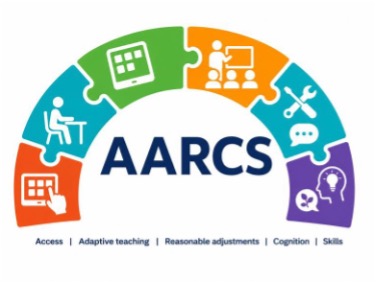
The CandLE AARCS model focuses on access, adaptive teaching, reasonable adjustments, cognition and skills as sequentially important in supporting the learner’s ability to show their understanding. The possession of, or access to, an AAC device does not guarantee that the student who relies on AAC will be able to use it without support.
Access
Access may be blocked by positioning, vision, hearing, sensory load, motor control, speed of selection, symbol or text layout, vocabulary availability, language level, memory demand or the reliability of the access method. A wrong answer may reflect a literacy difficulty, but it may also reflect a screen that is hard to see, a target that is too small, a scanning route that is too slow, a word that is not available, or a task that assumes speech-like speed.
This is why access assessment must come before firm judgements are made about literacy level. If access is not investigated first, schools run the risk of teaching at the wrong level through over-simplifying, because the learner cannot show what they know, or by overloading the learner because access needs have not been fully explored.
Adaptive Teaching
Once the learner’s access to the learning tools has been optimised consideration is needed around adaptive teaching to ensure that the learner is not disadvantaged by the way in which materials are presented and explained.
Adaptive teaching means adjusting teaching, materials, communication supports, scaffolding and response methods so that learners can access the same curriculum without lowering expectations. It is reflected in Teachers’
Standard 5 (DfE, 2021) which requires teachers to “adapt teaching to respond to the strengths and needs of all pupils” and aligns with the Education Endowment Foundation (2026) emphasis on checking understanding and adapting teaching in response to what pupils show during learning.
Adaptations for students who rely on AAC may include:
- extra processing and response time, without rushing or finishing sentences for them.
- access to their AAC system throughout the whole day in every
- alternative response methods, such as eye gaze, pointing, switch access, partner-assisted scanning, typing or selecting from
- reduced motor demands, for example fewer worksheet pages, larger targets, stable layouts or digital access.
- teaching that does not rely on spoken answers, oral blending, chanting or rapid verbal repetition.
- visual and written supports for key vocabulary, instructions and lesson structure.
- modelling language on the learner’s AAC system, rather than expecting independent use without demonstration of its use first.
- opportunities to write, spell, use word prediction and generate original
- accessible texts, including enlarged print, uncluttered pages, highlighting, audio support or digital text.
- communication partner support, including waiting, confirming, recasting and expanding what the learner
- assessment adjustments so the learner can show understanding without speech or handwriting being the barrier.
- age-respectful materials, especially for older learners who may still need foundational literacy teaching but not infant content.
Reasonable Adjustments
The Equality and Human Rights Commission explains that schools have a duty under the Equality Act 2010 to take reasonable steps to avoid substantial disadvantage for disabled pupils, including through changes to policies and practices and the provision of auxiliary aids and services where reasonable. For students who rely on AAC, this principle may translate into adjustments such as access to their AAC system, alternative response methods, adapted materials, extra processing time, trained communication partner support and exam access arrangements, guided by the learner’s normal way of working (Equality and Human Rights Commission, 2015; AAC Exams Access Working Group, n.d.; JCQ, 2026).
For AAC users, reasonable adjustments need to be implemented in ordinary classroom work including during literacy lessons. They may need a coordinated package of auxiliary aids, access methods, trained partner support, adapted materials, alternative response routes and exam arrangements so that speech, handwriting, motor access or processing speed do not become the real test.
Cognition: working memory, cognitive load and AAC
For students who rely on AAC it is important to consider how much mental effort the learner must use before they can think, read, write, communicate or demonstrate understanding. A learner may understand the content but be overloaded by the process of accessing it.
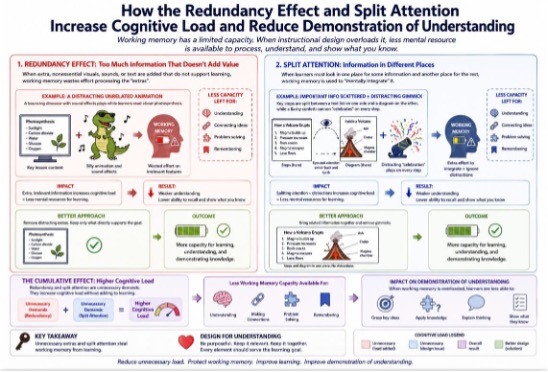
AAC use can place additional demands on working memory. The learner may need to hold an intended message in mind while searching for vocabulary, navigating pages, using word prediction, controlling their access method, listening to the teacher, watching the communication partner, and monitoring whether their message has been understood. Thistle and Wilkinson (2013) argue that aided AAC places distinctive demands on working memory because communication through a system requires the user to maintain and manipulate information while completing several linked actions.
This is important because working memory is limited. Cognitive Load Theory explains that new information must be processed through limited working memory before it can contribute to learning and long-term understanding (Sweller, van Merriënboer and Paas, 1998). If too much working memory is taken up by the format of the task, the learner has less available for comprehension, problem-solving, reading, writing or communication.
For students who rely on AAC, this means that poor performance may be misread as lack of understanding when the real issue is excessive cognitive load. A student may lose their answer while trying to move between the text, the question, their AAC vocabulary, a word-prediction list, a spelling grid, and the expectations of the adult waiting for a response. This is especially relevant for eye-gaze users, switch users, partner-assisted scanning users and learners with motor or sensory access needs, because the access method itself may already be using a significant amount of attention and working memory.
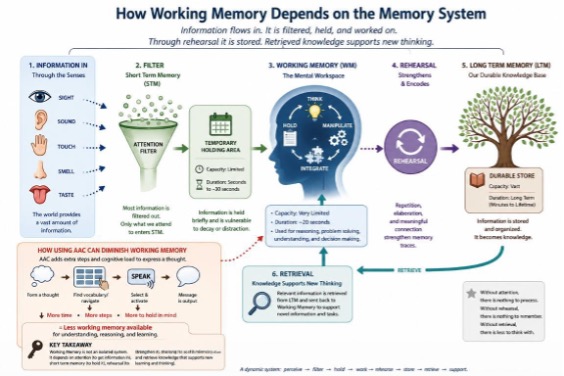
The redundancy effect is particularly relevant. Extra information is not automatically helpful. If similar facts are presented in several competing ways, the learner may have to process, compare or ignore unnecessary material. For example, adding symbols above every word in a reading passage may feel supportive, but if the teaching aim is reading text, the symbols may draw visual attention away from the print. Benson-Goldberg (2025) found that symbolised texts were associated with lower reading comprehension and slower reading than traditional text for individuals with intellectual and developmental disabilities, suggesting that symbols added to text can make access harder rather than easier.
The split-attention effect is also central. This occurs when learners must divide attention between two or more separate sources of information and mentally integrate them. In AAC literacy teaching, this might happen when the text is on one sheet, the symbols are elsewhere, the answer options are on the board, and the AAC vocabulary needed to respond is on a different page or device.
Cognitive load research shows that split attention places unnecessary demand on working memory because learners must hold separate pieces of information in mind and combine them before they can respond (Sweller, van Merriënboer and Paas, 1998; Chandler and Sweller, 1992).
Unnecessary cognitive load needs to be reduced without compromising the intellectual challenge. The aim is not to make the curriculum easier; but to remove avoidable barriers so that the learner’s mental effort is used for thinking, understanding and communicating. This means using clean layouts, reducing visual clutter, avoiding unnecessary symbolised text, placing prompts close to the point of use, reducing page-jumping, keeping vocabulary locations stable, allowing processing time, and separating the communication purpose from the literacy purpose.
AAC display design also matters. Light et al. (2019) reviewed evidence showing that AAC display features, including layout, symbol arrangement and visual design, affect visual attention and performance. In other words, the way the AAC system or learning material is organised can either support cognition or add unnecessary load.
Students who rely on AAC often present with a much more uneven learning profile than their non-disabled peers. Their cognitive understanding may be considerably stronger than their expressive output suggests. For example, a student may understand complex spoken language, follow curriculum-level discussion and make sophisticated choices, while still having very limited spelling skills or a slow, effortful method of producing written words. They may be able to read individual words accurately, but struggle to use those words flexibly in sentences, paragraphs or subject-specific contexts. This unevenness can easily be misread as a lack of ability when it is often the result of communication access, physical access, working memory demands, limited writing experience and reduced opportunities to practise independent composition. Assessment and teaching therefore need to look beyond isolated skills and consider what the learner can understand, what they can express with the right supports, and what barriers are preventing them from showing their full ability.
Approaches to teaching
Different approaches to teaching affect cognitive development in different ways. For students who rely on AAC, this is especially important because of the additional demands on working memory that they experience. The learner may need to hold an idea in mind while also searching vocabulary, navigating pages, selecting words, monitoring output and responding to the teaching task.
Cognitive load theory suggests that teaching should protect limited working-memory resources by reducing unnecessary, or extraneous, load, particularly the redundancy effect and split-attention effect (Paas et al., 2003; De Jong, 2010). Approaches that minimise negative effects on memory are therefore those that simplify access, integrate information clearly, avoid unnecessary duplication, reduce visual and linguistic clutter, provide worked examples and repeated practice, and ensure that the learner’s effort is directed towards the concept being taught rather than towards managing the physical aspects of the task or the AAC system (Thistle & Wilkinson, 2013).
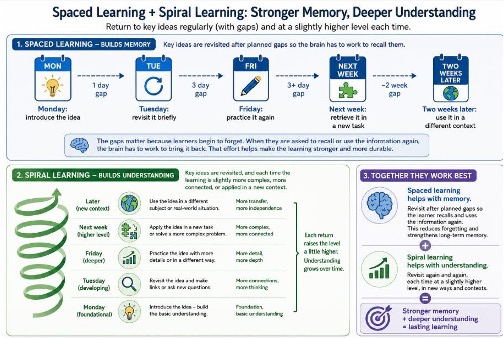
Spiral learning combined with spaced learning is generally preferable to block learning because it supports retention, transfer and cognitive development over time. In a spiral curriculum, key concepts are revisited repeatedly, with each return adding greater complexity, depth or independence. This means learners are not expected to master a concept in one isolated block before moving on; instead, understanding is built gradually through repeated encounters. Bruner argued that effective curricula should return to important ideas repeatedly, each time at a more advanced level, so that learners can connect new learning to what they already know (Bruner, 1960). When this is combined with spaced learning, practice is distributed over time rather than concentrated into a single intensive block. Learners usually retain information better when practice is spread across time rather than massed together in one session or short teaching block (Cepeda et al., 2006).
Block learning can support short-term performance during a concentrated teaching period, but it may not lead to secure long-term retention unless the knowledge is revisited and retrieved over time. The impression may be created that a learner has mastered a concept during the block, only for that learning to fade when the topic is no longer practised. Spiral and spaced approaches reduce this risk by allowing repeated retrieval, rehearsal and application in different contexts. For AAC users, this also gives repeated opportunities to practise the language, vocabulary, access method and response format needed for the task, rather than treating these as separate barriers to learning. Blocked practice may be useful when a new skill is first introduced, because it can reduce task complexity at the beginning. However, over-reliance on blocked teaching can limit generalisation. Research on spaced practice suggests that mixing and revisiting, such as in interleaved learning which moves between topics, can improve later performance more than practising one type of task in a single block (Rohrer, 2015). Therefore, for learners who rely on AAC, a spiral-and-spaced model is usually more supportive than a block model because it protects memory, reduces overload, strengthens retrieval and allows learning to become more flexible and independent.
AARCS questions for literacy teaching
|
AARCS area |
Questions to ask before judging literacy level |
|
Access |
Can the learner see, hear, reach, select, navigate and respond reliably? Is the vocabulary or spelling route available? |
|
Adaptive teaching |
Has the task been taught through a route the learner can use, without lowering the learning goal? |
|
Reasonable adjustments |
Is the learner being given the aids, access method, time, technology and support needed to avoid disadvantage? |
|
Cognition |
What does the learner understand, infer, reason, predict or remember when access barriers are reduced? |
|
Skills |
Which literacy skills are demonstrable now, and which need explicit teaching, modelling, practice and supported retrieval? |
Skills – the final piece in the puzzle
Synthetic phonics is not the only form of phonics teaching. It is one approach within a wider family of phonics and word-study approaches. The skills element of the AARCS model refers to the specific National Curriculum learning outcomes that make up literacy learning. Approaches to teaching now combine with learning outcomes so that the student can achieve.
Is synthetic phonics the only phonics approach? Give analytic phonics a central place.
Synthetic phonics is not the only form of phonics teaching. It is one approach within a wider family of phonics and word-study approaches. In synthetic phonics, learners are usually taught individual grapheme–phoneme correspondences and then blend sounds to read whole words. In analytic phonics, the direction is different: learners begin with whole, meaningful words and then analyse the letter–sound patterns within them. “Systematic” phonics does not have to mean “synthetic-only” phonics.
For AAC users, the question is not whether phonics matters. It has been established that it does. The question is how phonics can be taught accessibly, meaningfully and without placing unnecessary demands on speech, working memory, motor planning or speed of response. Many phonics programmes assume that learners can say sounds aloud, repeat words, segment quickly, blend orally, and respond in real time. These assumptions can disadvantage learners who rely on AAC, not because they cannot learn phonics, but because the teaching route is often built around speech production rather than literacy learning. Reviews of AAC literacy intervention show that phonological and decoding skills can improve when instruction is adapted, but also that AAC users are often excluded from phonological approaches because many programmes rely on verbal responses (Yorke et al., 2021; Linder et al., 2023).
Analytic phonics therefore deserves a central place for many AAC users because it starts with comprehension, known vocabulary and meaningful print.
The learner is not expected to manipulate isolated sounds with little context. Instead, they begin with a word, sentence or short text that already carries meaning. From there, the teacher can draw attention to spelling patterns, rimes, onsets, suffixes, base words and word families. This is still phonics, but it is phonics embedded in reading and writing rather than phonics treated as a prerequisite. A comprehensive literacy approach provides a more appropriate pathway for students with significant disabilities by embedding decoding and spelling within meaningful reading and writing. Rather than treating word-level skills as isolated targets, this model connects them to comprehension, vocabulary development, communication, composition and purposeful use of text (Erickson & Koppenhaver, 2020).
For example, a learner might begin with a personally meaningful sentence such as: I like playing games with my friends. The teacher can draw attention to play, then compare play, played and playing. The learner can notice that the base word stays the same, while -ed and -ing change the meaning and grammar. They can then build sentences such as I played yesterday, I am playing now, and I will play tomorrow. This teaches letter patterns, spelling, morphology, tense and sentence meaning together. For an AAC user, responses might be made by eye pointing, partner-assisted scanning, selecting from word cards, using word
prediction, choosing “same/different”, or constructing a sentence on their device. The important point is that the learner is engaging with print, sound-pattern relationships and meaning without being required to produce speech sounds orally.
The comprehensive approach is also well suited to English because English spelling is not a simple one-to-one sound code. Learners need to understand sound, spelling pattern and meaning. Research on English orthography shows that larger spelling units such as rimes and word patterns can be useful because English has inconsistent grapheme–phoneme relationships compared with more transparent orthographies (Goswami et al., 2005). Word study research also emphasises that spelling knowledge develops through attention to sound, pattern and morphology; older learners particularly need teaching that includes prefixes, suffixes, roots, spelling–meaning links and subject vocabulary (Templeton, 2020, 2025).
A teenager or adult who has already experienced repeated early synthetic phonics cycles is unlikely to benefit emotionally or educationally from being returned to another infant-style sequence of SATPIN, CVC blending and decontextualised sound drills. However, rather than phonics being stopped it should be repositioned within age-respectful literacy. Older learners need texts and tasks that match their age, interests and curriculum: non-fiction, music, sport, technology, politics, relationships, science, college life, work experience, personal narratives and real-world writing. Phonics can be taught through these materials by analysing key words, comparing word families, using spelling patterns to support word prediction, and building meaningful sentences and paragraphs.
A useful principle is phonics through text and task, not phonics before text and task. For AAC users, this reduces the risk that literacy becomes a narrow programme of sound drills while genuine reading and writing are delayed. It also supports motivation. Wyse and Hacking’s “double helix” view of reading and writing argues for teaching phonics alongside meaningful reading and writing rather than treating phonics as a narrow, separate route into literacy (Wyse & Hacking, 2024).
The main argument then, is not anti-phonics. It is anti-synthetic-only phonics as the default pathway for all AAC users. Synthetic phonics may still have a place, especially where specific grapheme–phoneme correspondences need to be taught explicitly. However, analytic phonics, analogy-based work, word study, morphology, sentence building and supported composition should be central.
For AAC users, the aim is not simply to pass through a phonics sequence; it is to become readers and writers who can use print for comprehension, communication, learning and independent expression.
Teach spelling through writing, keyboards and word prediction
AAC users need access to spelling early because, for them, spelling is a communication tool as well as a writing one. The learner who can approximate a spelling, select first letters, use an alphabetised word list or choose from prediction has a route beyond the fixed vocabulary on their device.
This means keyboards and word prediction should be introduced as literacy tools. Word prediction does not remove the need to teach spelling. It reduces unnecessary transcription load so the learner can practise using print for real purposes. It can also draw attention to first letters, word shape, morphology, vocabulary choice and sentence construction.
There will be times when prediction is switched off for a specific spelling assessment or carefully planned spelling practice activity. But in most writing tasks, the priority is communication, composition and curriculum access. If the learner is always forced to type without prediction, writing may become so effortful that it blocks the literacy development we are trying to build.
Use AAC phonics: first letters and the first two letters as practical access routes
AAC phonics brings spelling, phonics and access together. Instead of treating phonics only as the production or hearing of phonemes, it teaches learners how letters and letter combinations help them find the words they want to say or write.
For example, the first two letters of a word can become a powerful access unit. If a learner can select c then a, or c then o, this narrows the possible words in prediction. They begin to understand that letter choices are not arbitrary; they are cues into the word they want. The learner may not yet spell every letter unaided, but they are already using the alphabetic system generatively.
This is a more useful literacy route than leaving the learner restricted to a communication vocabulary because spelling is not yet accurate. Effective writing may develop before fully independent spelling. The teaching task is to build the bridge, not to withhold the bridge until the learner has crossed it unaided.
Different approaches to phonics:
|
Approach |
Starting point |
Why it matters for AAC users |
|
Synthetic phonics |
Part to whole, sound to word: phonemes and graphemes are blended and segmented. |
Important for code knowledge but can be inaccessible if it relies on fast oral rehearsal, speech-like output and heavy working-memory load. |
|
Analytic phonics |
Whole to part. Whole meaningful words are studied and compared before patterns are identified. |
Starts from meaning and known vocabulary; slower and more contextual; useful when comprehension is stronger than sound-by-sound blending. |
|
Analogic phonics |
Known patterns are used to read and spell new words, such as light, night, sight and bright. |
Reduces the need to decode every word from scratch and supports visual, rime and orthographic pattern learning. |
|
Embedded phonics |
Letter-sound links are taught as they arise in shared reading, writing and curriculum work. |
Keeps phonics connected to communication, enjoyment of story and purpose, rather than isolated drills. |
|
Morphology-informed teaching |
Roots, prefixes, suffixes and word families are taught explicitly. |
Links spelling to meaning; especially important for older learners, technical vocabulary and subject learning. |
|
Orthographic pattern learning |
Learners notice letter clusters, syllables, rimes, common endings and irregular high-frequency words. |
Builds fluent word recognition and spelling knowledge without relying only on sound-by-sound decoding. |
|
AAC phonics |
First letters, first two letters, keyboard layouts and prediction choices are taught as usable access routes into words. |
Supports practical writing. The learner may not yet spell every letter unaided, but can use the spelling system to select, predict and produce the intended word. |
Teaching through input, elaboration and output
Many literacy activities fail because teachers rush to test the student by expecting them to output answers before understanding is secure. The student is asked to write, spell, read aloud, answer or perform before there has been enough input and elaboration. This is especially risky for AAC users because output is often the hardest, slowest and most visible part of the task.
In the input phase, the teacher explains, models and makes the target accessible. This may include showing the word in a meaningful text, modelling the sound-spelling relationship, comparing it with a known word, explaining themorpheme or demonstrating how to find the word using a keyboard and word prediction.
In the elaboration phase, the learner practises with support. They might sort words, choose between similar spellings, complete sentence frames, use a word bank, compare word families, read a short passage, discuss vocabulary, use prediction options or build words or sentences initially with and then without a model.
In the output phase, the learner demonstrates understanding through an accessible route. That route might be typed writing, eye-gaze selection, a spelling grid, partner-assisted scanning, multiple choice options, sentence building, text-based AAC or independent composition with word prediction.
Adaptations to teaching should include ensuring that students who rely on AAC have ready access to input and elaboration and not just focus on a way of providing answers to test questions. So many of this group of learners miss learning through appointments, personal care and other factors and they need a way to independently revisit learning as well as a way of answering questions.
Current assumptions within the UK education system often divide learners into two broad groups: those who can access the National Curriculum and those who cannot. This is a blunt distinction. It fails to recognise learners who have strong cognitive potential but significant communication, physical, sensory or access needs.
As a result, cognitively able students who rely on AAC, or who require substantial physical access support, may be placed on educational pathways that do not match their cognitive potential. Communication and movement difficulties should not be treated as evidence of reduced cognition; researchers have warned that people with complex communication needs are often excluded or underestimated because of assumptions about their cognitive capability (Taylor & Balandin, 2020). Literacy research also shows that individuals who need or use AAC can acquire a wide range of literacy skills when they have effective tools, adapted teaching and trained support, but they are often excluded from literacy instruction or offered instruction that depends on spoken responses (Light et al., 2025).
This creates a particular risk within current educational pathways. Special and alternative provision can offer valuable support, but qualification access is uneven. FFT Education Datalab found that, in 2023, 65% of pupils in special schools were entered for at least one qualification, and only 15% achieved the basics at Level 1 in English/literacy and maths/numeracy (Thomson, 2025). The Department for Education has also commissioned analysis comparing GCSE English and maths outcomes for pupils with EHCPs in mainstream and special-school settings, covering 94,927 pupils between 2011 and 2024, which itself reflects the policy importance of setting and qualification access (DfE, 2026).
The main finding was that, among pupils with EHCPs who took GCSEs, those educated in mainstream schools achieved higher English and maths GCSE outcomes on average than comparable pupils educated in special schools.
Mainstream education is not automatically accessible either. Students who use AAC can be disadvantaged by fast-paced classroom discussion because they need time to compose, formulate and physically access responses. Quick, Geist and Erickson (2025) found that a common “call on and come back” strategy did little to solve the barrier and could create exclusion, disengagement, divided attention and missed learning opportunities. Research on AAC response time also shows that students often need partners to wait and model rather than repeat prompts or move on too quickly (Sun et al., 2023). This supports the argument that rapid block coverage may reduce genuine practice opportunities for AAC users. More generally, research on distributed practice shows that spacing practice over time supports longer-term retention better than massed practice, even where learning may look slower at first (Walsh et al., 2023).
There is therefore a significant gap in provision. At present, there is no clear educational pathway for students who have good cognitive skills but complex communication and physical access needs. There is also no sufficiently ambitious pathway for students who do have learning difficulties but who, with appropriate AAC access, adaptive teaching and reasonable adjustments, may be capable of progressing beyond basic skills. The problem is not simply learner capacity. It is the absence of accessible, age-respectful and qualification-focused routes that allow these learners to show what they know and to build futures equal to their potential.
There is a clear need for more coordinated planning and practice so that students who use AAC and/or have complex communication needs are supported to progress as far as possible towards increasingly independent curriculum access and literacy skills.
This aligns with national expectations that education, health and care partners work together to improve outcomes for children and young people with SEND, and that pupils with complex needs should be supported to access literacy instruction and make progress towards functional literacy where possible (DfE and DoH, 2015; DfE, 2023).
Conclusion
Supporting learners who rely on AAC is not about lowering expectations. It is about ensuring that there is no confusion between access barriers and literacy ability and potential.
Synthetic phonics opens one important door into literacy. For AAC users, it must not be mistaken for the whole building. Learners need phonics, but they also need spelling embedded in reading, comprehension, vocabulary, writing and curriculum access. They need analytic, analogic, embedded, morphology-informed and AAC-specific phonics alongside synthetic phonics. They need keyboards, word prediction, alphabetised word lists, modelled sentences and accessible response routes.
Most of all, they need adults to keep the real destination in view: not endless phonics practice, but becoming readers, writers, thinkers and communicators who can use literacy to learn, qualify, participate and write or say anything they want to.
What schools need to avoid and what they need to focus on
|
Stop |
Do instead |
|
Repeating early synthetic phonics sequences for months or years without increasing challenge. |
Use synthetic phonics as one tool within a spiral programme that revisits patterns in meaningful reading and writing. |
|
Interpreting poor oral blending or segmenting as proof of low literacy potential. |
Assess comprehension, visual word recognition, spelling attempts, keyboard use and response route separately. |
|
Making students wait until phonics is secure before giving keyboard or word prediction access. |
Introduce keyboards and word prediction early so spelling develops through real writing. |
|
Treating a communication vocabulary as enough for curriculum access. |
Teach spelling, technical vocabulary, morphology, alphabetised word lists and text-based AAC. |
|
Using descriptive teaching as a replacement for precise curriculum language. |
Use descriptive teaching to support understanding, while also teaching the actual words required for qualifications and subject learning. |
|
Rushing to output: ‘write the sentence’, ‘spell the word’, ‘answer now’. |
Provide input, elaboration and accessible routes before expecting independent output. |
|
Adding busy hooks, decorative visuals or confusing choices that increase cognitive load. |
Reduce redundancy and split attention; keep supports directly relevant to the learning target. |
|
Assuming some speech means the learner can access fast verbal phonics. |
Consider speed, effort, reliability, motor planning and AAC alternatives even for students with partial speech. |
A useful checklist for those supporting the literacy learning of students who rely on AAC:
- Begin with access: positioning, vision, hearing, sensory load, motor control, selection method, language level and available
- Involve multi-disciplinary teams of experts who have a thorough knowledge of AAC in ensuring that the student’s access, communication and learning are appropriately supported.
- Keep systematic synthetic phonics, but do not make it the only route into
- Use analytic and analogic phonics to teach meaningful word families, rimes and visual spelling patterns.
- Assess comprehension separately from speech, handwriting and unaided spelling. <li”>Teach embedded phonics during real reading, writing and curriculum activities.
- Teach morphology explicitly, especially for older learners and subject vocabulary.
- Introduce keyboards, alphabetised word lists and word prediction
- Use word prediction for writing unless the task is specifically a spelling assessment or carefully planned spelling-practice task.
- Build spelling through reading, comprehension, vocabulary and purposeful writing.
- Provide sentence frames, modelled examples, key words and AAC-accessible responses during whole-class teaching, not only afterwards with a teaching assistant.
- Use spiral and spaced learning: revisit after gaps, increase complexity and vary the context.
- Reduce unnecessary motor, memory and speed demands while keeping cognitive demand high.
- Expect uneven Reading comprehension may be much stronger than spelling, grammar or oral phonological demonstration.
- Keep the long-term goal visible: silent reading with comprehension and writing paragraphs and pages.
References
AAC Exam Access (n.d.) AAC Exam Access. Available at: https://aac.examsaccess.group/ (Accessed: 29 May 2026).
Ahlgrim-Delzell, L., Browder, D.M., Wood, L., Stanger, C., Preston, A.I. and Kemp-Inman, A. (2016) ‘Systematic instruction of phonics skills using an iPad for students with developmental disabilities who are AAC users’, Journal of Special Education, 50(2), pp. 86–97.
American Speech-Language-Hearing Association (ASHA) (n.d.) Augmentative and Alternative Communication (AAC). Available at: ASHA Practice Portal.
Benson-Goldberg, S. (2025). Symbolated texts as an assistive technology: Exploring the impact on reading comprehension. Research in Developmental Disabilities, 161, 104998.
Bowers, J. S. (2020). Reconsidering the evidence that systematic phonics is more effective than alternative methods of reading instruction. Educational Psychology Review, 32, 681–705.
Bruner, J. S. (1960). The Process of Education. Harvard University Press.
Cepeda, N. J., Pashler, H., Vul, E., Wixted, J. T., & Rohrer, D. (2006). Distributed practice in verbal recall tasks: A review and quantitative synthesis.
Psychological Bulletin, 132(3), 354–380.
Chandler, P. and Sweller, J. (1992). The split-attention effect as a factor in the design of instruction. British Journal of Educational Psychology, 62(2), 233–246.
Dahlgren Sandberg, A., & Hjelmquist, E. (1996). Phonologic awareness and literacy abilities in nonspeaking preschool children with cerebral palsy.
Augmentative and Alternative Communication, 12(3), 138–154.
De Jong, T. (2010). Cognitive load theory, educational research, and instructional design. Instructional Science, 38, 105–134.
Department for Education (2021) Teachers’ standards. Available at: GOV.UK.
Department for Education and Department of Health. (2015) Special educational needs and disability code of practice: 0 to 25 years. London: DfE/DoH.
Department for Education. (2023). The reading framework: Teaching the foundations of literacy. Department for Education.
Department for Education. (2026). GCSE outcomes for pupils with EHCPs: comparison of mainstream and special schools.
Education Endowment Foundation (2026) ‘Adaptive teaching in practice: using feedback to check…’. Available at: Education Endowment Foundation.
Equality and Human Rights Commission (2015) Reasonable adjustments for disabled pupils: guidance for schools in England. Available at: Equality and Human Rights Commission.
Erickson, K., Hanser, G., Hatch, P. and Sanders, E. (2009) Research-based practices for creating access to the general curriculum in reading and literacy for students with significant intellectual disabilities. Chapel Hill, NC: Center for Literacy and Disability Studies, University of North Carolina.
Erickson, K.A. and Koppenhaver, D.A. (2020) Comprehensive literacy for all: teaching students with significant disabilities to read and write. Baltimore, MD: Paul H. Brookes Publishing Co.
Fletcher, J. M., Savage, R., & Vaughn, S. (2021). A commentary on Bowers (2020) and the role of phonics instruction in reading. Educational Psychology Review, 33, 1249–1274.
Gjermestad, A., Skarsaune, S. N., & Bartlett, R. L. (2023). Advancing inclusive research with people with profound and multiple learning disabilities through a sensory-dialogical approach. Journal of Intellectual Disabilities, 27(1), 40–53.
Goswami, U., Ziegler, J. C., & Richardson, U. (2005). The effects of spelling consistency on phonological awareness: A comparison of English and German. Journal of Experimental Child Psychology, 92(4), 345–365. doi: 10.1016/j.jecp.2005.06.002
Hedrick, W.B., Katims, D.S. and Carr, N.J. (1999) ‘Implementing a multimethod, multilevel literacy program for students with mental retardation’, Focus on Autism and Other Developmental Disabilities, 14(4), pp. 231–239.
Joint Council for Qualifications (2026) Access arrangements and reasonable adjustments: adjustments for candidates with disabilities and learning difficulties, 1 September 2025 to 31 August 2026. Available at: JCQ.
Kuhn, M. R., Schwanenflugel, P. J., & Meisinger, E. B. (2010). Aligning theory and assessment of reading fluency: Automaticity, prosody, and definitions of fluency. Reading Research Quarterly, 45(2), 232–253.
Light, J. and McNaughton, D. (2014) ‘Communicative competence for individuals who require augmentative and alternative communication: a new definition for a new era of communication?’, Augmentative and Alternative Communication, 30(1), pp. 1–18. doi: 10.3109/07434618.2014.885080.
Light, J., McNaughton, D., Mandak, K., O’Neill, T., Wilkinson, K. and Batorowicz, (2019) ‘New and emerging AAC technology supports for children with complex communication needs and their communication partners: state of the science and future research directions’, Augmentative and Alternative Communication, 35(1), pp. 26–41. doi: 10.1080/07434618.2018.1557251.
Light, J., Holyfield, C., McNaughton, D., Nieder, D. and Preece, J. (2025)
‘Overcoming barriers to literacy for individuals who need or use AAC: lived experiences, key research findings, and future directions’, AAC: Augmentative and Alternative Communication, 41(3), pp. 283–294.
Linder, A-L., Geyer, M., Atzemian, M., Meuli, N., Martinet, C., de Chambrier, A-F. and Sermier Dessemontet, R. (2023) ‘Effects of adaptations of a phonics-based reading intervention program on reading and spelling skills of students with intellectual disability who require augmentative and alternative
communication’, Frontiers in Education, 8.
Murray, J. (2018), AAC and Literacy intervention: a review of literature.
Manchester Metropolitan University.
Peeters, M., Verhoeven, L., de Moor, J., & van Balkom, H. (2009). Importance of speech production for phonological awareness and word decoding: The case of children with cerebral palsy. Research in Developmental Disabilities, 30(4).
Proud, P. (2021) Current literacy interventions for AAC users. PhD thesis. University of Nebraska-Lincoln.
Paas, F., Renkl, A., & Sweller, J. (2003). Cognitive load theory and instructional design: Recent developments. Educational Psychologist, 38(1), 1–4.
Quick, N. A., Geist, L., & Erickson, K. (2025). AAC-mediated classroom participation: Calling on and coming back. Journal of Interactional Research in Communication Disorders, 15(4), 297–330. doi: 10.3138/jircd-2024-0013
Rohrer, D. (2015). Interleaved practice improves mathematics learning. Journal of Educational Psychology, 107(3), 900–908.
Rose, J. (2006). Independent review of the teaching of early reading: Final report. Department for Education and Skills.
Sun, T., Bowles, R., Douglas, S. N., & Plavnick, J. (2023). Response time of young children with complex communication needs following a communication opportunity. Exceptional Children, 90(1).
Sweller, J., van Merriënboer, J.J.G. and Paas, F.G.W.C. (1998). Cognitive architecture and instructional design. Educational Psychology Review, 10(3), 251–296.
Taylor, S., & Balandin, S. (2020). The ethics of inclusion in AAC research of participants with complex communication needs. Scandinavian Journal of Disability Research, 22(1), 108–115. doi: 10.16993/sjdr.637
Templeton, S. (2020). Stages, phases, repertoires, and waves: Learning to spell and read words. The Reading Teacher, 74(3), 315–323. doi: 10.1002/trtr.1951
Templeton, S. (2025). The implications and applications of developmental spelling after phonics instruction. Education Sciences, 15(2), 195. doi: 10.3390/educsci15020195
Thistle, J.J. and Wilkinson, K.M. (2013). Working memory demands of aided augmentative and alternative communication for individuals with developmental disabilities. Augmentative and Alternative Communication, 29(3), 235–245.
Thomson, D. (2025). Key Stage 4 attainment indicators for special and alternative provision schools. FFT Education Datalab.
Van Tatenhove, G.M. (2009) ‘Building language competence with students using AAC devices: Six challenges’, Perspectives on Augmentative and Alternative Communication, 18(2), pp. 38–47. doi: 10.1044/aac18.2.38.
Walsh, M. M., Krusmark, M. A., Jastrembski, T., Hansen, D. A., Honn, K. A., & Gunzelmann, G. (2023). Enhancing learning and retention through the distribution of practice repetitions across multiple sessions. Memory & Cognition, 51, 455–472.
Wyse, D., & Bradbury, A. (2022). Reading wars or reading reconciliation? A critical examination of robust research evidence, curriculum policy and
teachers’ practices for teaching phonics and reading. Review of Education, 10, e3314.
Wyse, D., & Hacking, C. (2024). Decoding, reading and writing: The double helix theory of teaching. Literacy, 58(3), 256–266.
Witkowski, D. and Baker, B. (2012) ‘Addressing the content vocabulary with core: Theory and practice for nonliterate or emerging literate students’, Perspectives on Augmentative and Alternative Communication, 21(3), pp. 74–
- doi: 10.1044/aac21.3.74.
Wotherspoon, J., Whittingham, K., Sheffield, J., & Boyd, R. N. (2023). Cognition and learning difficulties in a representative sample of school-aged children with cerebral palsy. Research in Developmental Disabilities, 138, 104504.
Yorke, A.M., Caron, J.G., Pukys, N., Sternad, E., Grecol, C. and Shermak, C. (2021) ‘Foundational reading interventions adapted for individuals who require augmentative and alternative communication (AAC): a systematic review of the research’, Journal of Developmental and Physical Disabilities, 33(4), pp. 537–582.