
Spiral and Spaced Learning Combine to be the most Appropriate Adaptive Teaching Strategy for Students who rely on Augmentative and Alternative Communication (AAC) – Perhaps for all learners?
Author: Marion Stanton, PGCE, AAC/AT accredited (Level 7), MA (online and distance education), Adv. Dip. Ed. (Special), MCCT
James is a year 10 student in a mainstream school who uses Augmentative and Alternative Communication (AAC) to communicate and as an Assistive Technology (AT) solution for learning.
He needs to answer a maths question by stating the next two numbers in the sequence: 4 10 16 22 28
He had no difficulty working out that there were 6 numerals between each number and indicated 34. He then spent some time looking at the question again before adding 38 incorrectly. With a little questioning it became clear that by the time James came to the second part of the question he had forgotten the question and the interval that he had originally identified. He noticed the number 4 and made a stab at adding 4.
What was happening here? Working memory failure followed by impulsive behaviour.
Memory
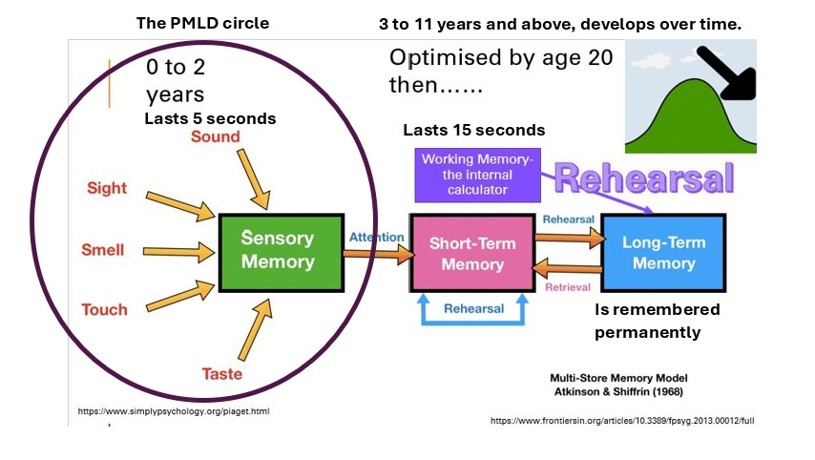
Working memory is “a brain system that provides temporary storage and manipulation of the information necessary for such complex cognitive tasks as language comprehension, learning, and reasoning.” Baddeley (1992). According to Cambridge Cognition and Brain Sciences Unit (n.d.). working memory holds temporary information in mind while using it to accomplish a task. In the case of James, he needed to remember the 6-digit interval whilst applying it to a question. The time it took for him to move between the relevant parts of the information disrupted his ability to manipulate the information.
Information held in short-term/working memory is rapidly lost within seconds unless it is actively rehearsed, refreshed, or supported. Classic experimental work suggests that unrehearsed verbal information may decay substantially within about 15–20 seconds, Peterson and Peterson (1959). Repetition and rehearsal helps information to become organised and retrievable. Through repetition information is encountered or said again. Through rehearsal the person actively repeats or refreshes the information internally or externally while carrying out the task. Rehearsal supports working memory by refreshing information that would otherwise rapidly fade, keeping it available for attention, sequencing and task completion. Maintenance rehearsal, such as repeating a phone number until you dial it, can keep information active temporarily, but durable learning is more likely when learners process its meaning, connect it with existing knowledge, and retrieve and apply it in context. Repetition alone may increase familiarity, but repeatedly completing the same activity does not necessarily produce secure or transferable learning (Craik and Lockhart, 1972; Craik and Tulving, 1975; Karpicke and Roediger, 2008). Repeating information can keep it active in memory for a short time, but learning is more likely to become secure when learners connect it with meaning, relate it to existing knowledge, and use it in different contexts.
Information is more likely to be stored in long-term memory when the learner pays attention to it, processes it meaningfully, connects it to what they already know, uses it, and retrieves it again over time. This stored knowledge supports performance in tests and exams because relevant information can be retrieved from long-term memory into working memory when needed. However, many test items do not rely on recall alone: they also require the learner to hold and manipulate new information in working memory, while drawing on background knowledge retrieved from long-term memory.
Meaningful processing improves memory more effectively than surface repetition. Retrieving information from long-term memory strengthens long-term retention more effectively than repeated studying alone.
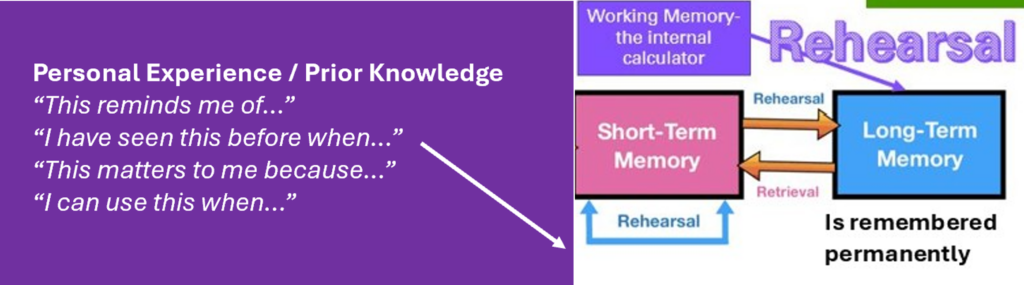
Encoding stored knowledge in long-term memory, while retrieval brings knowledge back into working memory. Encoding is the process of taking in information, making sense of it, and linking it to what we already know so it can be stored in long-term memory and retrieved when needed.
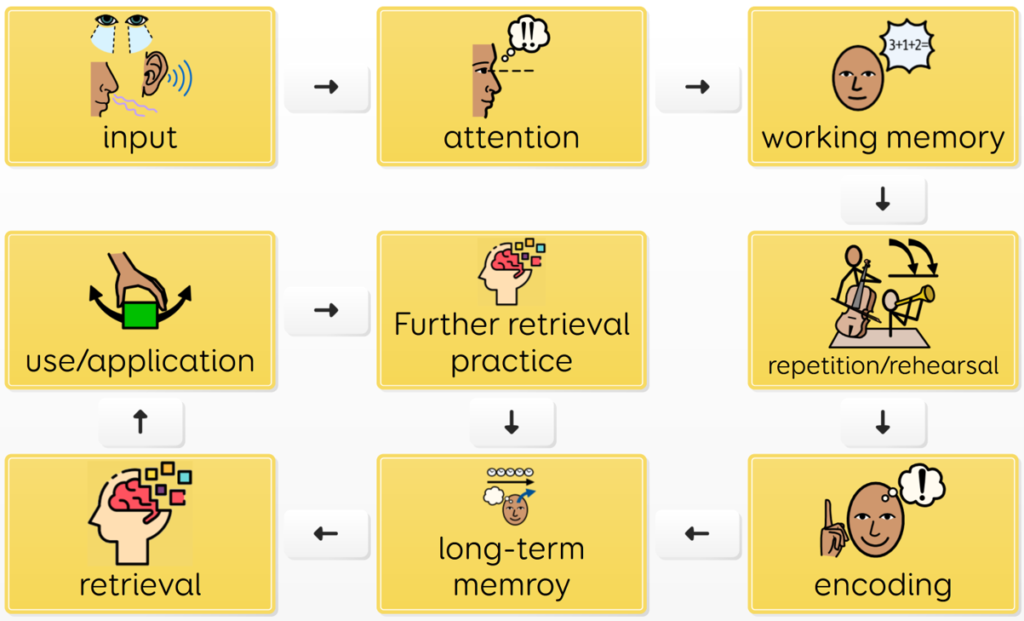
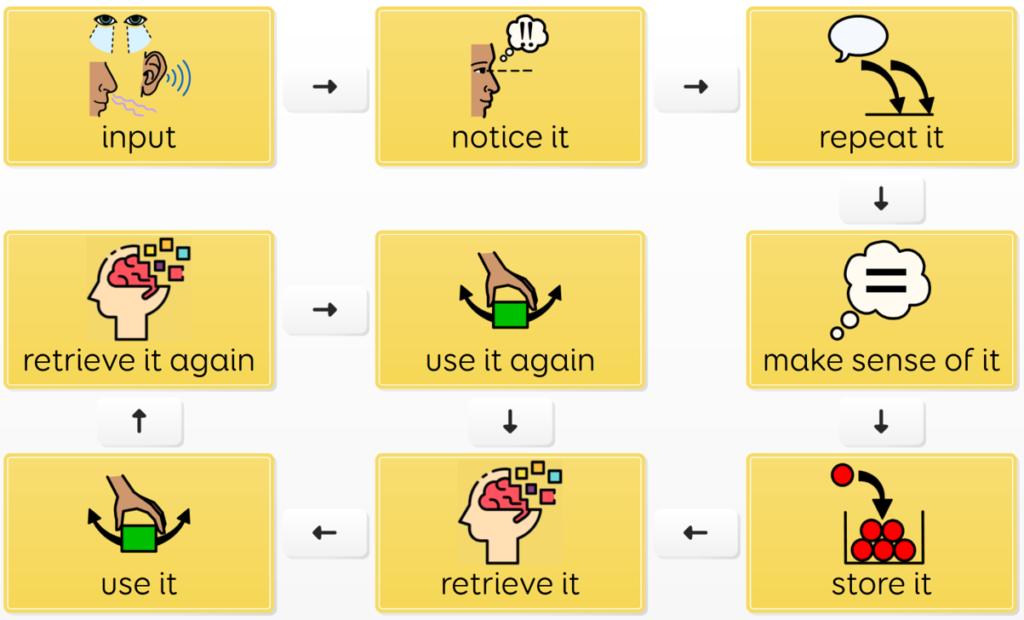
Information must first be attended to and held in working memory. Repetition and rehearsal help keep it active, but long-term learning depends on meaningful encoding, connection to prior knowledge, and repeated retrieval over time. The important message is that repetition alone is not enough. Repetition keeps information active for a short time. Encoding and retrieval are what make it more likely to become useful long-term knowledge.
What happens when information drops out of working memory?
When information drops out of working memory, the learner may not have “chosen” to ignore the task. They may have lost the mental thread. At that point, they need to pause, return to the input, and reset the memory cycle.
If they cannot inhibit the urge to act quickly, guess, rush, abandon the task, or fill the gap with an impulsive response, the cycle is broken before encoding can happen. This is generally associated with a lack of self-regulation and difficulties with executive function.
Executive functions include processes such as planning, inhibition, working memory, cognitive flexibility and monitoring. Ferguson, Brunsdon and Bradford (2021) found that working memory capacity and planning continued to improve across adolescence and into young adulthood, which supports the argument that older students are still developmentally able to benefit from support and practice.
Self-regulation means being able to manage your thoughts, attention, emotions and actions so that you can work towards a goal. It includes actions such as:
- stopping before acting automatically or impulsively
- rushing when an instruction is lost
- work out what to do first, next and last
- checking whether a strategy is working
- changing an approach if stuck
- reflecting on what worked and what should be done next time.
Self-regulation is what allows a learner to notice that information has dropped out of working memory, pause rather than guess or rush, and deliberately reset the learning cycle by looking back, asking for repetition, rehearsing the information again, and then continuing.
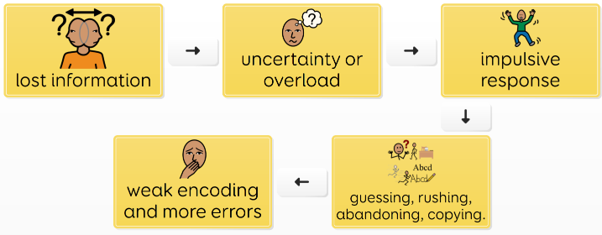
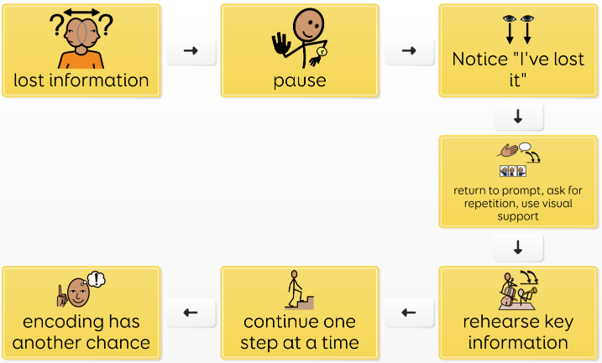
Self-regulation is the learner’s ability to manage the learning process, especially when things become difficult. It includes noticing confusion, controlling the impulse to rush, choosing a strategy, checking whether it works, and resetting when necessary. For learners with working-memory difficulties, self-regulation must often be externally supported through prompts, visuals, modelling, extra time and non-judgemental repetition (Education Endowment Foundation, 2025; Gathercole and Alloway, 2007).
Why AAC users may be affected by these issues despite having good cognitive ability.
Students who rely on AAC may experience forgetting, impulsive responding or task abandonment more often because AAC use increases the cognitive and executive demands of communication. Aided AAC requires the learner to maintain the intended message in working memory while navigating vocabulary, locating symbols or letters, managing access methods, inhibiting irrelevant selections, monitoring output and repairing breakdowns, Thistle and Wilkinson (2013). These demands occur at the same time as the academic task itself. When the learner loses the original instruction or thought, the difficulty may appear as rushing, guessing or non-compliance, but it is often better understood as a breakdown in the memory–attention–communication cycle. Appropriate support therefore includes reducing working-memory load, providing visual and written prompts, allowing additional time, modelling reset strategies, and training communication partners to wait, repeat and support without taking over.
Why the current approaches to teaching in mainstream may disadvantage AAC user.
The current mainstream teaching system often disadvantages AAC users in both literacy and mathematics because it measures learning through speech, speed, handwriting, rapid recall and conventional classroom participation. In literacy, this can mean that phonics, reading comprehension, vocabulary, spelling and writing are taught through oral responses and written output that AAC users cannot access quickly or independently. In maths, it can mean that number facts, calculation, reasoning and problem-solving are judged through mental recall, spoken explanation, written workings and timed performance, rather than through accessible demonstrations of mathematical thinking. As a result, the learner’s access demands, navigating AAC, finding vocabulary, composing responses, managing motor access, holding information in working memory and waiting for a communication partner can be mistaken for weak understanding. The issue is therefore not that AAC users require a reduced curriculum, but that literacy and maths teaching must be redesigned so that communication access, recording methods, wait time, vocabulary, modelling and alternative response routes are built into the lesson from the start, Light et al (2025).
Block teaching and limited return to earlier learning
A further disadvantage is that mainstream teaching often organises literacy and mathematics into blocks of learning. A class may focus on fractions, persuasive writing, algebra, poetry, grammar, measurement or comprehension for a few weeks, then move on to the next unit, with limited systematic return to the earlier learning until revision periods before assessments or exams. This model assumes that pupils can retain, retrieve and apply previous learning after a long gap. For many AAC users, that assumption is problematic.
Students who use AAC may receive fewer opportunities for active participation and rehearsal during classroom learning. They may therefore benefit from additional, spaced opportunities to retrieve vocabulary and concepts and to use them across activities, communication partners and contexts (Andzik, Chung and Kranak, 2016; Benson-Goldberg and Erickson, 2024). This should not be interpreted as evidence that they are unable to learn the content. Rather, limited progress may reflect restricted opportunities to respond, explain their thinking, ask questions, receive feedback, correct misunderstandings and use new knowledge independently.
These opportunities are particularly important because generating a response through AAC can require additional time to formulate the message, locate the required vocabulary and operate the communication system. Fast-paced classroom discussion can therefore create participation barriers, particularly when teaching continues before the learner has had time to construct and contribute a response (Sun et al., 2023; Quick, Geist and Erickson, 2025). Consequently, when a class moves rapidly to a new topic, an AAC user may still be consolidating access to the relevant vocabulary, their method of responding and the underlying concept. Additional retrieval practice and repeated, meaningful use across time can support more durable learning and transfer (Karpicke and Roediger, 2008; Yorke et al., 2018).
This is particularly significant in literacy and mathematics because both subjects depend on cumulative knowledge and skills. In literacy, vocabulary, phonics, spelling patterns, fluency, sentence structures, comprehension strategies and writing skills need to be taught systematically and revisited through meaningful use over time (Department for Education, 2024; Benson-Goldberg and Erickson, 2024). In mathematics, new learning builds on secure earlier understanding and on connections between mathematical ideas. Progression should therefore be based on the security of the learner’s understanding and readiness to move on, with earlier knowledge consolidated through further practice where necessary (Department for Education, 2021; Murray, Horner and Göbel, 2025).
For some AAC users, apparent forgetting or lack of understanding may reflect insufficient accessible opportunities to retrieve, express, discuss and apply learning, rather than an inability to learn the content. This is particularly plausible where access to AAC is inconsistent, individual opportunities to participate are limited, or insufficient time and AAC modelling are provided for the learner to formulate and contribute a response (Andzik, Chung and Kranak, 2016; Sun et al., 2023; Benson-Goldberg and Erickson, 2024).
The difficulty becomes more acute when schools postpone substantial review until the period immediately before examinations. Late, concentrated revision may improve short-term performance, but spaced study and retrieval practice distributed throughout a course are generally more effective in supporting durable learning (Soderstrom and Bjork, 2015; Carpenter, Pan and Butler, 2022). Revision is therefore most effective when it reactivates and strengthens earlier learning, rather than providing the learner’s first sustained opportunity to retrieve, organise and apply it.
For students who use AAC, compressed revision may create additional barriers. Revision activities frequently require learners to retrieve information quickly, formulate written or spoken explanations, organise knowledge and complete practice questions within limited periods. Producing a response through AAC may additionally involve formulating the message, locating appropriate vocabulary and operating the communication system. Research shows considerable individual variation in AAC response time and identifies fast-paced classroom interaction as a barrier to participation (Light and McNaughton, 2014; Sun et al., 2023; Quick, Geist and Erickson, 2025).
Consequently, late-stage revision may provide a misleading picture of attainment. A student may understand important curriculum content but be unable to retrieve and express that understanding quickly enough through the available response method. Apparent failure may therefore reflect the conditions under which learning must be demonstrated, as well as the security of the underlying knowledge. Regular spaced retrieval, accessible practice activities, appropriate AAC vocabulary, adequate response time and structured support for organising learning are more likely to provide a fair opportunity to consolidate and demonstrate knowledge across the course (Soderstrom and Bjork, 2015; Carpenter, Pan and Butler, 2022).
Can special schools and colleges offer a viable alternative route to qualifications and employment?
Special schools and specialist colleges do not automatically provide an appropriate alternative for every learner who uses AAC, particularly where assessment indicates that the learner’s principal barriers concern communication, physical access and access to teaching rather than reduced cognitive potential. Specialist settings vary considerably, so suitability should be determined by whether the setting can provide the curriculum, subject teaching, qualifications, communication access and academic progression required by the individual learner.
National data demonstrate a substantial difference in access to GCSE pathways. Across the period examined by the Department for Education, approximately 45% of pupils with EHCPs in mainstream schools were entered for GCSE English and mathematics, compared with approximately 8% of pupils with EHCPs in special schools. Pupils in special schools also typically entered fewer GCSEs overall. These figures do not establish that individual pupils were wrongly placed or capable of undertaking GCSEs, but they demonstrate that placement and access to qualification pathways are closely connected (Department for Education, 2026a).
For an AAC user who requires access to literacy, mathematics, subject teaching, qualifications and age-appropriate academic progression, a specialist placement may therefore offer increased adult support and environmental flexibility while still creating an educational disadvantage if it does not provide an appropriately ambitious curriculum or recognised qualification pathway. The relevant distinction is not simply between mainstream and special education, but between a placement that removes the learner’s access barriers and one that responds to those barriers by reducing the curriculum.
There is also emerging policy evidence that educational setting is associated with qualification outcomes. A Department for Education analysis of 94,927 pupils with EHCPs who took GCSEs between 2011/12 and 2023/24 found that, after controlling for Key Stage 2 prior attainment, primary type of SEN and demographic characteristics, pupils in mainstream schools achieved an average of 0.56 of a grade higher on the combined English-and-mathematics outcome measure than comparable pupils in special schools. The association was particularly marked for pupils with physical disabilities, at 0.65 of a grade, and specific learning difficulties, at 0.63 of a grade (Department for Education, 2026a).
The report is appropriately cautious. It identifies an association rather than proof that mainstream placement causes better results, because it cannot fully account for differences in the severity and complexity of pupils’ needs. It also applies only to the approximately 22% of pupils with EHCPs who had the necessary prior-attainment data and were entered for GCSEs, and it does not measure wellbeing, social development, independence or life-skills outcomes. Its findings must therefore inform, rather than determine, decisions about individual placement (Department for Education, 2026a).
This direction is reflected in the 2026 SEND reform consultation. The proposals emphasise developing a more inclusive mainstream system, improving teacher training, increasing access to assistive technology and drawing specialist expertise into mainstream settings through outreach and partnership. The consultation also proposes that specialist settings should become centres of excellence that support the wider system and states that pupils with complex needs should be helped to access as much of the curriculum as possible. It proposes a review of curriculum practice in special schools, indicating that curriculum ambition and access cannot simply be assumed on the basis that a setting is specialist (Department for Education and Department of Health and Social Care, 2026).
Placement does not, by itself, determine attainment. It does, however, shape access to curriculum content, subject-specific teaching, qualification entry, peer learning, repeated practice, retrieval opportunities and valid methods of demonstrating knowledge. For pupils whose main barriers involve communication, physical access, sensory access or a specific learning difficulty rather than reduced cognitive potential, mainstream education may provide stronger access to age-related curriculum and GCSE pathways, but only where effective support, appropriate AAC provision and reasonable adjustments are consistently available.
The solution may therefore involve building specialist AAC access into the curriculum pathway that best matches the learner’s assessed academic potential. This may include robust communication systems, communication-partner training, adapted literacy and mathematics teaching, assistive technology, additional processing and response time, repeated retrieval practice and alternative methods of responding and recording.
This position is consistent with AAC literacy research. Individuals who need or use AAC can acquire a wide range of literacy skills when provided with effective tools, evidence-based adapted teaching and appropriately trained professionals. Conversely, literacy development may be restricted when instruction depends upon spoken responses, practitioners lack relevant training, or the AAC system does not adequately support the transition from symbols to alphabetic reading and writing (Light et al., 2025). Adapted foundational reading interventions have produced large and very large effects across different ages, diagnoses and literacy skills, demonstrating that inability to produce speech sounds should not be interpreted as inability to acquire phonological and decoding skills (Yorke et al., 2021). Meaningful opportunities to interact, an AAC system that fits the learner and trained communication partners are similarly important to language development and participation (Holyfield et al., 2025).
How could Spiral and Spaced Learning Help?
Spiral and spaced learning may be particularly valuable for students who rely on AAC because they address a significant weakness in conventional block teaching. In many mainstream classrooms, a topic is taught intensively, then set aside until formal revision is required. This model assumes that learners had sufficient accessible opportunities during the original teaching period to understand, practise, retrieve and apply new knowledge independently. For many AAC users, however, restricted response time, limited opportunities for active participation and insufficiently adapted practice mean that initial learning may remain fragile. Revisiting content systematically over time can therefore provide repeated opportunities to consolidate understanding, strengthen retrieval and support more independent application.
Spiral Learning
Spiral learning means that key ideas are deliberately revisited over time, with each return becoming more complex or more connected to new learning. This is linked to Bruner’s idea of the spiral curriculum, where learners revisit important concepts repeatedly and at increasing levels of difficulty, Bruner, J.S. (1960). A summary of the spiral curriculum identifies three key features: pupils revisit a topic several times, complexity increases with each revisit, and new learning is linked to earlier learning, Harden and Stamper (1999).
Spiral learning is not simply repeating the same lesson. It is a planned cycle in which important ideas are returned to over time, but each return adds something new. The learner first meets an idea in an accessible form. They then practise it with support, leave it for a period of time, and later retrieve it again. On each revisit, the task becomes more complex, more independent or more connected to other areas of learning. This means that earlier learning is not left behind; it becomes the foundation for later learning.
For example, a pupil might first learn the idea of cause and effect through a simple picture sequence. Later, they revisit the same idea in a short story. Later again, they use it in history, science or persuasive writing. The concept is the same, but the demand gradually increases.
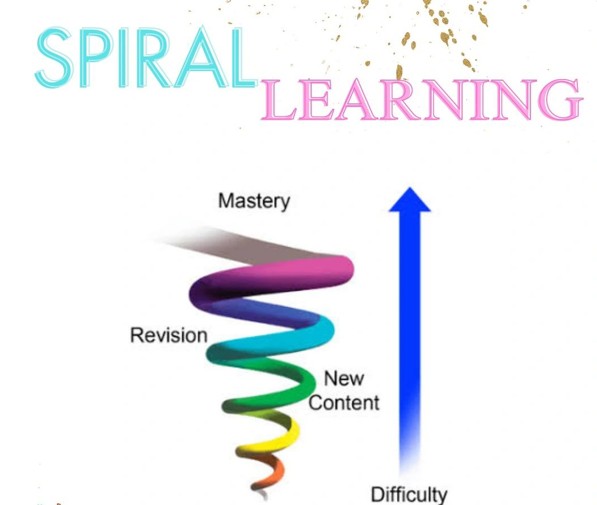
As the student is repetitively exposed to the topic of interest, s/he is able to better understand it and solidify their knowledge regarding it.
Each revisit allows for a deeper understanding of the topic.
With each revisit, the teacher builds upon the prior knowledge, instead of starting fresh.
The student becomes comfortable with the topic, being able to implement the knowledge and advance their future learning by probing questions.
The student is confident in moving on to the next grade, having learned this topic comprehensively.
Other Benefits include:
- If the student’s knowledge wasn’t solidified in the previous school year, this teaching approach will help them catch up and not feel left behind.
- Despite the student’s age, s/he will be able to learn the concepts due to the structure of this teaching method.
- If the student has missed a school year/part of the school year, then the concepts will be revised enough times to complete the missed gap!”
Spaced Learning
Spaced learning distributes practice across several sessions over time, rather than concentrating it within a single block. Unlike spiral learning, which revisits topics at increasing levels of complexity, spaced learning schedules repeated encounters with previously taught material at intervals designed to strengthen retention and reduce forgetting.
Memory is strengthened when learners return to information after a gap and try to retrieve it again.
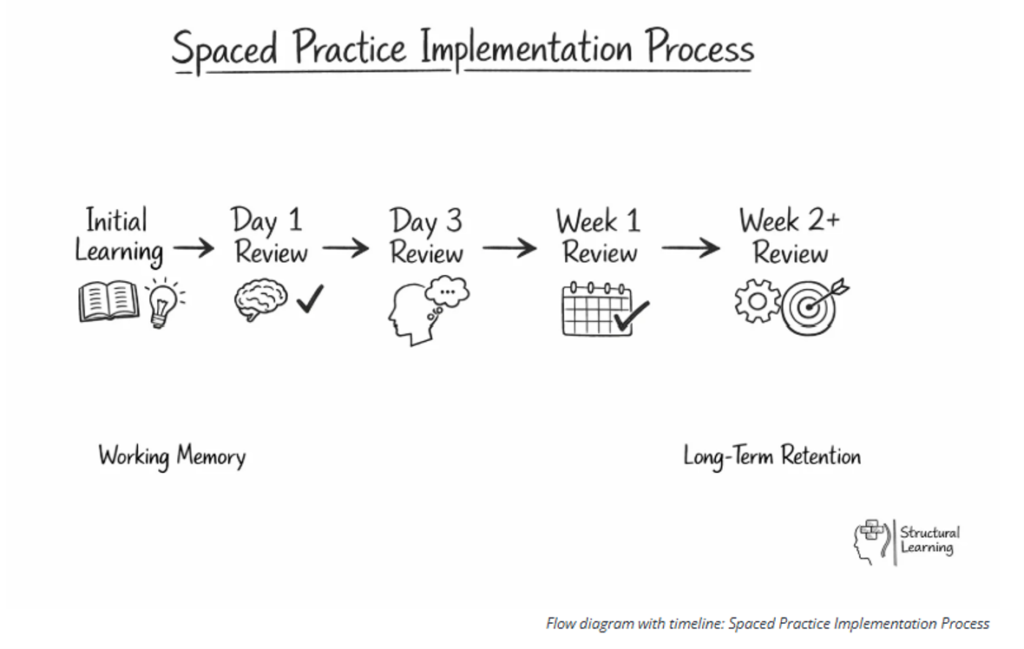
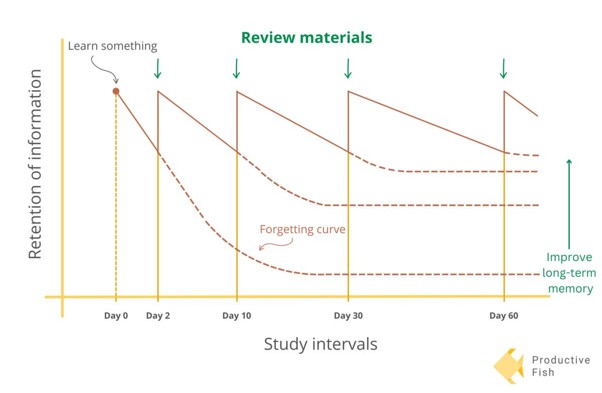
Ebbinghaus forgetting curve with spaced repetition shows that:
- retention falls rapidly after initial learning;
- each review restores recall;
- after each successful review, forgetting becomes slower;
- consequently, the time before the next review can gradually increase.
Spaced learning distributes practice across time. Each return to previously learned material strengthens retention and reduces subsequent forgetting, allowing the interval between reviews to increase gradually (Cepeda et al., 2006; Ebbinghaus, 1913).
Dunlosky and colleagues (2013) identify practice testing and distributed practice as two of the most effective learning strategies because they support learning across ages, abilities and curriculum materials. Cepeda et al.’s review of distributed practice (2006) drew on hundreds of studies and found that spacing learning episodes affects later retention. The Education Endowment Foundation (EEF, n.d.) also explains that retrieval practice strengthens both how easily information can be recalled and how durable that recall becomes, while low-stakes quizzes can reveal gaps and misconceptions.
How Spiral and Spaced Learning can help Students who rely on AAC
For AAC users, this is not just a memory issue. It is also an access issue. The first time a concept is taught, the AAC user may be dealing with several demands at once: understanding the lesson, locating vocabulary, navigating the AAC system, managing motor access, composing a response, waiting for a partner to notice, and coping with the pace of the classroom. That means they may have fewer active opportunities to rehearse and retrieve the actual learning than their speaking peers. Spiral and spaced teaching give the learner repeated chances to come back to the concept when the access route is more familiar.
Spiral and spaced learning may provide a more appropriate curriculum structure for AAC users because they replace one-off exposure with planned return, retrieval and consolidation. In a blocked curriculum, an AAC user may only just be gaining access to the vocabulary, symbols, motor patterns, concepts and response methods needed for a topic when the class moves on. Spiral learning allows key literacy and mathematical ideas to be revisited at increasing levels of complexity, while spaced learning ensures that earlier knowledge is practised and retrieved across time rather than left dormant until exam revision. This is particularly important for AAC users because learning is often slowed not by lack of understanding, but by the additional access demands involved in navigating AAC, composing responses, using assistive technology, managing working memory and relying on skilled communication partners. A spiral and spaced approach therefore supports memory, language, access and confidence, while preserving curriculum ambition.
How this would look in literacy:
In literacy, spiral and spaced learning would mean returning regularly to phonics, vocabulary, spelling patterns, sentence construction, comprehension and writing, not as isolated “catch-up” tasks, but as part of daily learning. This fits with AAC literacy approaches that stress repeated opportunities to engage with reading and writing. Erickson and Koppenhaver (2020) argue that students need repeated daily opportunities to use text meaningfully, and that alphabet knowledge and phonological awareness should not become the sole focus of instruction.
A comprehensive approach to literacy supports students who rely on AAC. Instead of teaching persuasive writing for three weeks and then leaving it, the teacher might return every week to the same core skills: giving an opinion, choosing evidence, using ‘because’, building a sentence, improving a word choice, and writing for an audience. The AAC user would meet the same concepts repeatedly, but with increasing independence and complexity. The ability to spell as they write would be embedded in the active writing experience as opposed to being a precursor to it.
How this would look in maths
In maths, spiral and spaced learning would mean regularly revisiting number, place value, calculation, fractions, measurement, reasoning and problem-solving. Instead of teaching fractions as a single block and then returning months later for revision, the learner would repeatedly meet fractions in short, accessible ways: matching images to symbols, comparing halves and quarters, using fraction vocabulary, solving practical problems, explaining choices, and connecting fractions to division, ratio or measure over time.
Mathematical understanding often depends on language: more than, less than, equal, altogether, difference, share, half, quarter, estimate, prove, explain, because. If those words are not available, modelled and practised repeatedly on the AAC system, the student may be unable to show mathematical reasoning even when they understand the concept.
Spiral and spaced learning do not lower expectations for AAC users; they make high expectations more realistic by giving learners repeated, accessible opportunities to retrieve, use and extend knowledge across time.
Practical tips
Pavlik & Anderson (2005) found distributed practice can be used as follows:
- Brain Dump Starters: Begin lessons with 3-minute free recall where students write everything they remember about a previous topic. This retrieval practice strengthens memory traces and identifies gaps before new learning begins.
- Spiral Homework Design: Structure homework with 60% new content and 40% review from previous weeks. Rotate the review questions each assignment to ensure comprehensive coverage of the curriculum over time.
- Low-Stakes Weekly Quizzes: Implement brief 5-question quizzes covering material from different time periods. Include one question from last lesson, two from last week, and two from last month for optimal spacing intervals.
- Retrieval Grids: Create classroom displays with topic grids where students regularly revisit and add information. Use these for quick whole-class retrieval at spaced intervals throughout the term.
- Interleaved Practice Problems: Mix problem types from different units rather than blocking similar problems together. This interleaving combined with spacing creates stronger neural connections between related concepts.
- Flashcard Rotation Systems: Implement the Leitner box method where correctly answered cards move to less frequent review boxes. Incorrectly answered cards return to daily review, creating personalised spacing schedules.
- Cumulative Testing: Design assessments that include questions from all previous units, not just current material. This testing effect combined with spacing significantly improves long-term retention rates.
- Exit Ticket Cycling: Use exit tickets that include one question about today’s learning and one from a spaced interval (last week, last month). Track responses to identify content requiring additional review sessions.
- Knowledge Organisers Review: Incorporate regular retrieval from knowledge organisers at expanding intervals. Students self-quiz on previous sections before adding new information to their organisers.
- Elaborative Questioning: During spaced review sessions, ask students to explain why and how concepts work rather than just recalling facts. This deeper processing strengthens memory consolidation during distributed practice.
- Peer Teaching Rotations: Schedule peer explanation sessions where students teach previously learned concepts to classmates. The preparation and teaching process serves as powerful spaced retrieval practice.
- Spaced Writing Tasks: Assign writing tasks that require students to synthesise information from multiple spaced learning sessions. Essays that connect current and previous topics reinforce long-term memory formation.
REFERENCES
Andzik, N.R., Chung, Y.-C. and Kranak, M.P. (2016) ‘Communication opportunities for elementary school students who use augmentative and alternative communication’, Augmentative and Alternative Communication, 32(4), pp. 272–281. doi: 10.1080/07434618.2016.1241299.
Baddeley, A. (1992) ‘Working memory’, Science, 255(5044), pp. 556–559. Available at: https://doi.org/10.1126/science.1736359
Benson-Goldberg, S. and Erickson, K.A. (2024) ‘Reported and enacted emergent literacy instruction: Understanding young students with extensive support and complex communication needs’ opportunity to learn’, Topics in Early Childhood Special Education, 44(1), pp. 6–19. doi: 10.1177/02711214241235404.
Bruner, J.S. (1960) The Process of Education. Cambridge, MA: Harvard University Press.
Cambridge Cognition and Brain Sciences Unit (n.d.) Introduction to Working Memory. University of Cambridge. Available at: https://www.cne.psychol.cam.ac.uk/introduction-to-working-memory (Accessed: 11 May 2026).
Carpenter, S.K., Pan, S.C. and Butler, A.C. (2022) ‘The science of effective learning with spacing and retrieval practice’, Nature Reviews Psychology, 1, pp. 496–511. doi: 10.1038/s44159-022-00089-1.
Cepeda, N.J., Pashler, H., Vul, E., Wixted, J.T. and Rohrer, D. (2006) ‘Distributed practice in verbal recall tasks: a review and quantitative synthesis’, Psychological Bulletin, 132(3), pp. 354–380.
Craik, F.I.M. and Lockhart, R.S. (1972) ‘Levels of processing: A framework for memory research’, Journal of Verbal Learning and Verbal Behavior, 11(6), pp. 671–684. doi: 10.1016/S0022-5371(72)80001-X.
Craik, F.I.M. and Tulving, E. (1975) ‘Depth of processing and the retention of words in episodic memory’, Journal of Experimental Psychology: General, 104(3), pp. 268–294. doi: 10.1037/0096-3445.104.3.268.
Department for Education (2021) National curriculum in England: mathematics programmes of study. London: Department for Education.
Department for Education (2024) The reading framework: Teaching the foundations of literacy. London: Department for Education
Department for Education (2026) GCSE outcomes for pupils with EHCPs: mainstream versus special school settings. London: Department for Education.
Dunlosky, J., Rawson, K.A., Marsh, E.J., Nathan, M.J. and Willingham, D.T. (2013) ‘Improving students’ learning with effective learning techniques: promising directions from cognitive and educational psychology’, Psychological Science in the Public Interest, 14(1), pp. 4–58.
Ebbinghaus, H. (1913). Memory: A contribution to experimental psychology (H. A. Ruger & C. E. Bussenius, Trans.). Teachers College, Columbia University. (Original work published 1885)
Education Endowment Foundation (2025) Metacognition and self-regulated learning: guidance report. 2nd edn. London: Education Endowment Foundation.
Erickson, K.A. and Koppenhaver, D.A. (2020) Comprehensive Literacy for All: Teaching Students with Significant Disabilities to Read and Write. Baltimore, MD: Paul H. Brookes Publishing Co.
Ferguson, H.J., Brunsdon, V.E.A. and Bradford, E.E.F. (2021) ‘The developmental trajectories of executive function from adolescence to old age’, Scientific Reports, 11, Article 1382.
Gathercole, S.E. and Alloway, T.P. (2007) Understanding working memory: A classroom guide. London: Harcourt Assessment.
Harden, R.M. and Stamper, N. (1999) ‘What is a spiral curriculum?’, Medical Teacher, 21(2), pp. 141–143. doi: 10.1080/01421599979752.
Karpicke, J.D. and Roediger, H.L. III (2008) ‘The critical importance of retrieval for learning’, Science, 319(5865), pp. 966–968. doi: 10.1126/science.1152408.
Light, J. and McNaughton, D. (2014) ‘Communicative competence for individuals who require augmentative and alternative communication: A new definition for a new era of communication?’, Augmentative and Alternative Communication, 30(1), pp. 1–18. doi: 10.3109/07434618.2014.885080.
Light, J., et al. (2025) ‘Overcoming barriers to literacy for individuals who need or use AAC: lived experiences, key research findings, and future directions’, Augmentative and Alternative Communication.
Murray, E., Horner, A.J. and Göbel, S.M. (2025) ‘A meta-analytic review of the effectiveness of spacing and retrieval practice for mathematics learning’, Educational Psychology Review. doi: 10.1007/s10648-025-10035-1.
Pavlik, P.I. Jr. and Anderson, J.R. (2005) ‘Practice and forgetting effects on vocabulary memory: an activation-based model of the spacing effect’, Cognitive Science, 29(4), pp. 559–586.
Peterson, L.R. and Peterson, M.J. (1959) ‘Short-term retention of individual verbal items’, Journal of Experimental Psychology, 58(3), pp. 193–198.
Quick, N.A., Geist, L.A. and Erickson, K.A. (2025) ‘AAC-mediated classroom participation: Calling on and coming back’, Journal of Interactional Research in Communication Disorders, 15(4), pp. 297–330. doi: 10.3138/jircd-2024-0013.
Soderstrom, N.C. and Bjork, R.A. (2015) ‘Learning versus performance: An integrative review’, Perspectives on Psychological Science, 10(2), pp. 176–199. doi: 10.1177/1745691615569000.
Sun, T., Bowles, R., Douglas, S.N. and Plavnick, J. (2023) ‘Response time of young children with complex communication needs following a communication opportunity’, Exceptional Children, 90(1), pp. 27–42. doi: 10.1177/00144029221146574.
Thistle, J.J. and Wilkinson, K.M. (2013) ‘Working memory demands of aided augmentative and alternative communication for individuals with developmental disabilities’, Augmentative and Alternative Communication, 29(3), pp. 235–245.
Yorke, A.M., Light, J.C., Gosnell Caron, J., McNaughton, D.B. and Drager, K.D. (2018) ‘The effects of explicit instruction in academic vocabulary during shared book reading on the receptive vocabulary of children with complex communication needs’, Augmentative and Alternative Communication, 34(4), pp. 288–300. doi: 10.1080/07434618.2018.1506823.