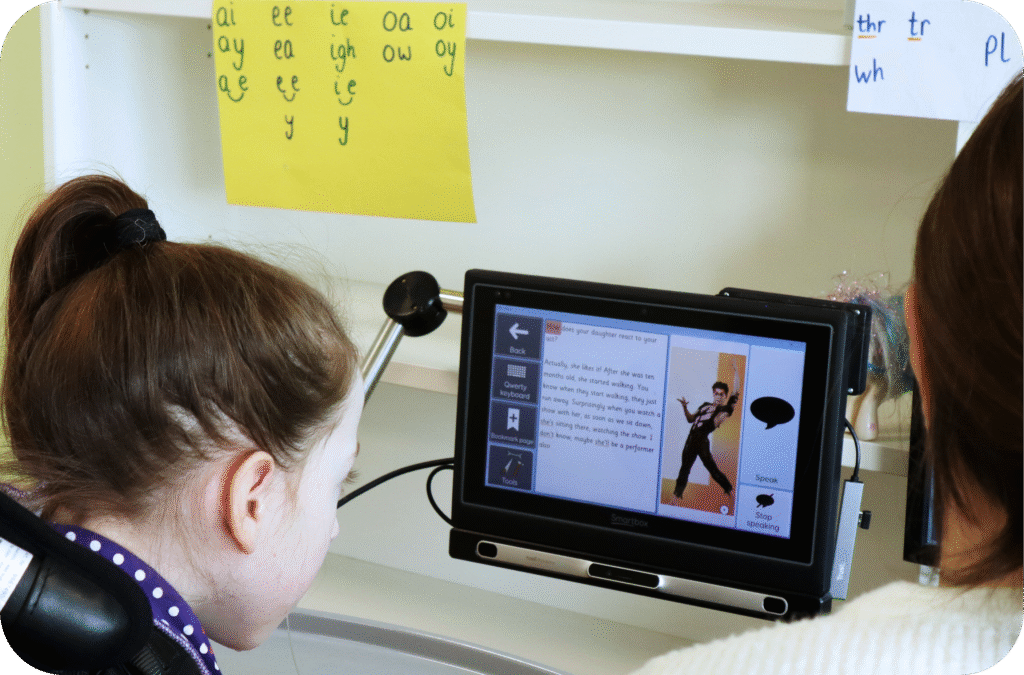
CandLE provides specialist educational assessments for students who require or rely on Augmentative and Alternative Communication (AAC) and/or Assistive Technology (AT).
Our assessments are carried out by qualified teachers with specialist expertise in curriculum access for students using AAC and AT. They are dynamic, student-centred and individualised, focusing not simply on what a student can do under existing conditions, but on what they may be able to achieve when barriers to communication, physical access and learning are reduced.
Our aim is to understand the student as a learner and identify the support, technology, teaching approaches and adaptations that could enable them to access learning as effectively and independently as possible.
What can CandLE assess?
Assistive Technology – We can assess the student’s Assistive Technology needs and identify appropriate hardware and software to support curriculum access.
Augmentative and Alternative Communication (AAC) – We can explore how AAC can support both communication and access to education.
Curriculum Access – Our curriculum access assessments consider how a student can access teaching, learning activities and the recording of their learning in the most time-efficient and least physically demanding way for them.
Literacy and Numeracy – We can explore aspects of literacy and numeracy learning, including the student’s current access to appropriate instruction and their potential to develop further skills.
Exam Access Arrangements – CandLE can support educational settings to understand a student’s normal ways of working, reasonable adjustments and potential examination access requirements.
Is a CandLE assessment right for this student?
Struggles to show what they know because of access needs.
Finds accessing learning slow, tiring or physically demanding.
Uses AAC or Assistive Technology, but their current system does not fully support communication, learning or recording of work.
Appears to understand more than they can demonstrate through their current communication or access method.
Needs learning materials or teaching approaches adapted so that they can participate more independently in the curriculum.
Needs their literacy, numeracy or learning potential explored using assessment approaches that take account of their communication and physical access needs.
May need exam access arrangements or reasonable adjustments, to fir their usual way of accessing and recording learning.
Is approaching a transition, such as moving to secondary school, college or another educational setting, and their future technology, communication or curriculum access needs need to be understood.
Has an EHCP that may not fully reflect their current access and learning needs.
Requires specialist teaching strategies and programmes as part of an Education Other Than At School (EOTAS) package at a community or home location.